News in 2026

|
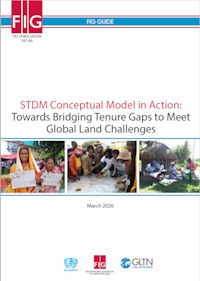
STDM Conceptual Model in Action: Towards Bridging Tenure Gaps to Meet
Global Land Challenges
March 2026
A new FIG publication - number 86 in the FIG Publication Series has
been published.
|
Authors are Eva-Maria Morscher-Unger, Jaap
Zevenbergen and John Gitau and the publication is
jointly published by FIG and UN-Habitat - Global Land Tool
Network GLTN with the support of The Netherlands Cadastre, Land
Registry and Mapping Agency – Kadaster
The Social Tenure Domain Model (STDM) is an innovative
concept, model, and information tool designed to address gaps in
conventional land administration systems by recognising and
documenting all people-to-land relationships, including
non-formal and customary rights along the continuum of land
rights.
This publication examines the evolution of STDM and its
growing role in addressing global challenges such as food
security; Housing, Land and Property (HLP) rights for displaced
populations, migration and climate resilience.
|
In her foreword FIG President Diane Dumashie states:
"This publication stands as a testament to the power of
collaboration, innovation, and community-driven solutions in the pursuit
of sustainable development. It is hoped that this work will be widely
used and that the evolution and adaptability of the STDM Conceptual
Model continue for decades to come."
STDM has demonstrated its capacity to enhance land tenure security,
particularly for marginalised populations such as slum dwellers,
smallholder farmers, women, and displaced communities. Its application
in diverse settings has shown how secure tenure is the basis of adequate
housing, improves living conditions, fosters agricultural productivity,
reduces land disputes, strengthens land-based revenue and supports
sustainable land management. Furthermore, STDM has proven to be a
valuable tool in post-conflict and post-disaster contexts, helping to
document and restore land rights, enabling communities to rebuild their
livelihoods.
In the early years of GLTN (2006 -2010) STDM was developed as a
multi-partner pro-poor land tool in support of sustainable land
management. It was seen as the key tool for implementing the GLTN
foundational concept of a “continuum of land rights” and presented in
the joint
FIG/GLTN publication (FIG Pub. 52, 2010).
Now, after 15 years, this publication provides an insight into the
further evolution and use of STDM including its integration with the
Land Administration Domain Model (LADM), which is recognised as a
normative annex in the ISO standard, a significant milestone.
STDM as part of the Land Administration Domain Model (LADM) has
further strengthened its relevance, ensuring compatibility with an
international ISO standard, and so enhancing interoperability with
national land administration systems.
STDM has evolved into a transformative concept for inclusive and
sustainable land administration. Its alignment with international
frameworks and its proven adaptability across diverse contexts position
STDM as a crucial enabler for all.
Ombretta Tempra, UN-Habitat writes: "This
publication comes at a time when global priorities are shifting, making
STDM evenmore relevant. Food security demands stronger recognition of
smallholder and women farmers’ land rights. The climate crisis requires
data and tools that help communities adapt and manage risks.
Displacement and conflict continue to uproot millions, underscoring the
urgency of protecting Housing, Land and Property (HLP) rights. Globally,
the adoption of STDM as an annex to the revised ISO Land Administration
Domain Model (LADM) elevates it from an alternative approach to an
internationally recognized pathway for inclusive land administration.
These priorities reflect GLTN’s commitment to securing land rights for
all and align closely with UN‑Habitat’s Strategic Plan, which places
housing, land and basic service" and continues: "UN‑Habitat
remains determined to continue working with GLTN partners to bridge the
gap between global policy and local experiences and to advance land
tenure security, good land governance and fit-for-purpose land
administration as a drivers of equitable and sustainable development,
for a more dignified future for all."
Louise Friis-Hansen
March 2026